
Present:
During the City Beautiful Movement at the turn of the 20th century, city planners used classical architecture to romanticize the imperialistic military ambitions of San Francisco’s wealthiest 1%, all of whom were heavily invested in the arms industry. San Francisco’s City Hall and Civic Center were focal points for this architectural movement.
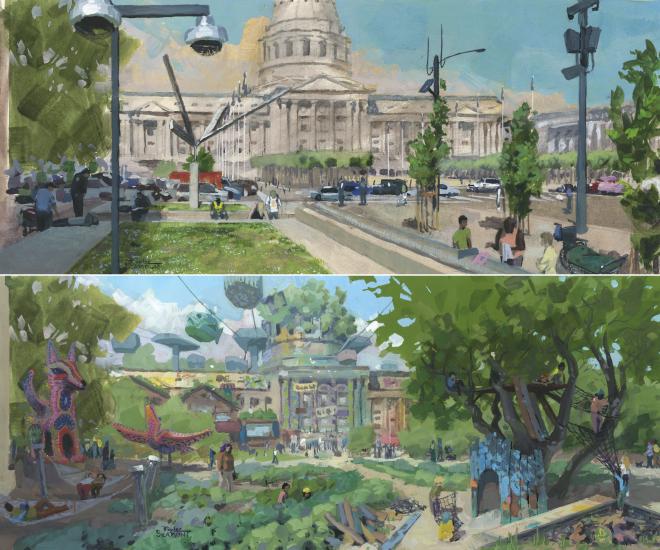
Today, the suffering caused by wealth disparity is evident everywhere in San Francisco, and not least in Civic Center, where many people make their lives on the streets. This painting highlights elements of hostile architecture and policy observed in the area: surveillance cameras (foreground), speakers that play Disney music at all hours (mounted on the light post on the right), the lack of benches, and security guards tasked with preventing people from lying down.
From left to right: a security guard checks on someone who won’t immediately sit up, a person sits after being told to do so and makes the best of the moment by drawing in a sketch book, a custodian takes a break, a man watches over his partner experiencing withdrawal, and three friends discuss politics while sorting through their belongings.
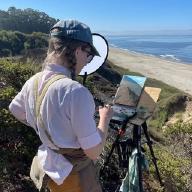
Observed and painted en plein air. Inspired by Imperial San Francisco, by Gray Brechin.
Future:
City Hall has been repurposed as a co-created community space. Its formerly bare walls and columns are decorated by artists who tell a people’s history of the city and extol the sacred values that inform the city’s future. During the Uprising, activists removed and repurposed the dome, viewing it as symbolic of hierarchy. Miraculously, a madrone took root at the base of the stairs in the central hall and grew up to burst out of the space of the former dome, becoming the tallest madrone ever on record. The roof now serves as a transfer station for the gondola lines that criss-cross the city. The building is still a beloved space for weddings and rites of passage.
Open and welcoming public spaces have returned to the city. In the foreground is a public hammock space, alebrije statues, a native plant garden, an adventure playground centered around a live oak tree, and a preserved piece of the City Hall’s facade, which kids have painted on. The kids play with fishing nets and invent ways to incorporate them into their treehouse.
This vision is inspired by The Fifth Sacred Thing by Starhawk and dreamed in collaboration with local resident, writer, and activist Beverly Litkin.